

The answer may not be so simple. Most spiritual people would answer quickly: yes, God is omniscient, he knows everything. Some might follow Augustine’s philosophy that God created time and is outside of time so he sees past, present, and future all at once. I’m not so sure. I’ve been taking a deep dive into researching this.
Why? Someone I mentor asked the question and I want to answer her well, but I think I’m really researching for a much more personal reason. When my daughter died, it happened with no warning and it made me question: God, if you knew this would happen, and you speak to me, why didn’t you tell me? Why didn’t you warn me? God’s silence made it seem almost as if he was just as surprised as I was. How do I make sense of this paradox? Is God all-knowing and also surprised?
When Jesus’s good friend Lazarus died, Jesus knew that he would raise him back to life. AND he also wept (John 11:1-35). If he knew the happy ending, why did he weep? How real were those tears?
I don't think we can think about God’s omniscience without also considering his incarnation. God has not chosen to live outside of our timeline. He’s chosen to live with us. Even as he knows where creation is headed, he’s not eager to skip to the ending too fast. He wants to live on our timeline, with us in all of our emotions and turmoil as we are living it, not as someone who is already at the finish line just waiting for us to catch up.
We would also be foolish to live in the present without hopefully anticipating the future. Jesus’s life, death, and resurrection, give us a taste, the “first fruits” of what’s to come (1 Cor. 15:20, Rom. 8:23). As Christians, our theology is rooted in the promise of that good future.
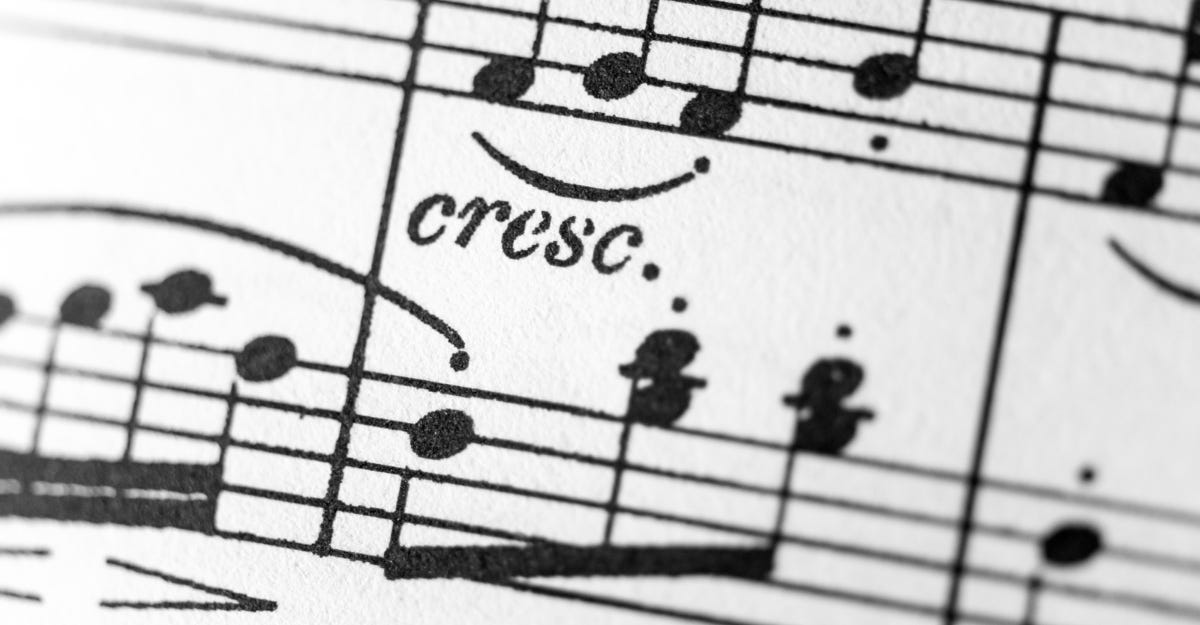
Theologian and musician, Jeremy Begbie, uses music to help us understand these complex concepts. In a song, there is a series of tensions and resolutions, beginnings and endings, that all propel you towards the climactic ending:
…in hearing or listening to music, because of its metrical wave structure we are always between the tones, on the way from tone to tone; our hearing does not remain with the tone, it reaches through and beyond it. There is a sense in which the musical present is charged with its future. This…does not entail positing a mental act whereby we present to our consciousness now some particular future musical event; rather, though the possible futures are by no means unlimited, we enjoy the dynamism of expectation itself…*
Because of Jesus, we can live fully in the present, feeling and holding all the beauty and tension without rushing through it too quickly. AND we can live with hopeful expectation of the climactic ending, because the smaller tensions and resolutions of the present give a taste of a much greater resolution.
I like Begbie’s musical analogy because sometimes I think we think of life with God too flatly. We say things like, “Well, God knows the future” or “God’s not surprised this happened” as if God is looking at us from on high as we move from point A to point B. But perhaps we don’t need those flat answers as much as to live in the dynamic mystery of incarnation and anticipation.
Questions for Reflection:
What do you like about Begbie’s music analogy? How does that help you?
How do you need Jesus to be with you today? Fully present to all of your thoughts and emotions and experiences?
How is Jesus inviting you into hopeful expectation? Are there smaller tensions that are resolving in your life that propel you towards a greater future?
*Begbie, Jeremy S. Theology, Music and Time. Cambridge: (Cambridge University Press, 2000), 111.